Paonta Sahib is situated on the bank of the river Yamuna. A Gurudwara is dedicated to the tenth sikh guru, Guru Gobind Sigh, who spent five years here.
The name of the city is derived from Paonta meaning "foot", either because Guru Gobind Singh set foot on this place or, according to an alternate story, he lost an ornament which he wore on his foot called "Paonta" while bathing in the Yamuna river.
Legend surrounds the ruins of the old capital of the Raja Sirmouri Tal, not very far from Paonta Sahib. The palace was destroyed by the curse of a court dancer when the Raja went back on his word of giving half of his kingdom to the dancer in case she crossed a narrow gorge on a rope.
This she did but the wily Raja then offered her the entire kingdom if she could dance her way back. She started back but as she was half way across, he cut the rope hurling the helpless girl into the stream.
Floods followed which swept away the city, the Raja and the royal house, as a result of dancer's curse.
Vishawkarma temple and few other Hindu temples are also located in Paonta Sahib.
Showing posts with label yamuna. Show all posts
Showing posts with label yamuna. Show all posts
Tuesday, February 23, 2010
Tuesday, February 16, 2010
Story of why yamuna's water is darker than that of ganga.
Story 1
After losing his first consort Sati who killed herself by jumping in the fire-pit of the priest-king Daksha, Shiva lost all interest in worldly life. He held his wife’s corpse and wandered aimlessly in the world until Vishnu cut the corpse into tiny pieces.
To rid himself of the sorrow, the gods requested Shiva to bathe in the river Yamuna. His sorrow scorched the river black.
Annexure
Later Shiva took another consort, Parvati, princess of the mountains. Once a demon called Raktabija terrorized the world. Every drop of his blood gave rise to his clone making it impossible for the gods to kill him. To help the gods, Parvati drank every drop of Raktabija’s blood. The blood darkened Parvati’s skin and she became known as Kali, the dark one. This form so terrified Shiva that he looked away. To regain his interest, the goddess bathed in the Yamuna and emerged as Gauri, the radiant one. Yamuna let the dark colour percolate in her being. Yamuna has thus been associated with accepting the sorrows and pollutions of the world. That is why her mood is always forlorn.
(courtesy :http://devdutt.com)
After losing his first consort Sati who killed herself by jumping in the fire-pit of the priest-king Daksha, Shiva lost all interest in worldly life. He held his wife’s corpse and wandered aimlessly in the world until Vishnu cut the corpse into tiny pieces.
To rid himself of the sorrow, the gods requested Shiva to bathe in the river Yamuna. His sorrow scorched the river black.
Annexure
Later Shiva took another consort, Parvati, princess of the mountains. Once a demon called Raktabija terrorized the world. Every drop of his blood gave rise to his clone making it impossible for the gods to kill him. To help the gods, Parvati drank every drop of Raktabija’s blood. The blood darkened Parvati’s skin and she became known as Kali, the dark one. This form so terrified Shiva that he looked away. To regain his interest, the goddess bathed in the Yamuna and emerged as Gauri, the radiant one. Yamuna let the dark colour percolate in her being. Yamuna has thus been associated with accepting the sorrows and pollutions of the world. That is why her mood is always forlorn.
(courtesy :http://devdutt.com)

Friday, February 12, 2010
how the Bandarpoonch peaks got their name

It is said after Hanuman set afire the city of Lanka, he buried his burning tail in the Himalayan snow to put out the flames.
The snow melted to give rise to Yamuna.
That is the why the peak next to Yamotri, the source of the Yamuna in the Himalayas, is known as Bandarpoonch or monkey’s tail. The ash made Yamuna’s waters dark.
Tuesday, January 12, 2010
yamuna in himachal pradesh
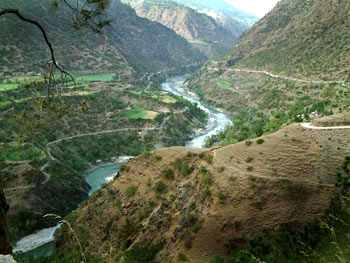 Yamuna enters Himachal Pradesh at Khadar Majri in Sirmaur district. It is the Eastern-most river of Himachal Pradesh. Its tributaries are Tons, Pabbar and Giri or Giri Ganga.
The Giri Ganga rises from near Kupar peak just above Jubbal town in Shimla district, Tons from Yamunotri and Pabbar from Chandra Nahan Lake near the Chansal peak in Rohru tehsil of Shimla district. Its total catchment area in Himachal Pradesh is 2,320 km. It leaves the state near Tajewala and enters into the Haryana state.
The area drained by the Yamuna system includes Giri-Satluj water divide in Himachal Pradesh to the Yamuna Bhilagana water divide in Gharwal.
Sunday, January 10, 2010
Tuesday, January 5, 2010
Hatni kund in haryana

Hathni Kund is in Haryana, built on a raised plinth overlooking the Yamuna. The river Yamuna flows into the plains of Haryana after crossing over the last lap of the Himalayan foothills at Paonta Sahib. The waters of the western Yamuna Canal are collected in the barrage at Tajewala, 5 km away from Hathni Kund.
The spot is a common area for camping, rafting, and hiking in the Kalesar forest reserve
Monday, December 28, 2009
a religious travel video:flow with yamuna
Gurudwara Ponta Sahib and Kapal Mochan
Gurudwara Paonta sahib on the banks of river Yamuna between city Nahan (Himachal Pardes) & Dehradun.
Gurudwara Dastaar asthan sahib,kavi Darbar sahib,birth place of Sahibzada Baba Ajit Singh ji, Sikh Art Museum.
Gurudwara kapal mochan near Balaspur jagadhari (Hariyana).
Gurudwara Paonta sahib on the banks of river Yamuna between city Nahan (Himachal Pardes) & Dehradun.
Gurudwara Dastaar asthan sahib,kavi Darbar sahib,birth place of Sahibzada Baba Ajit Singh ji, Sikh Art Museum.
Gurudwara kapal mochan near Balaspur jagadhari (Hariyana).
Sur ghat in Delhi
The Sur ghat is loacted at wazirabad.wonder where it got this name? has the name come from sur dynasty?
The Sur was the Afghan dynasty that ruled northern India (1540-56), founded by Sher Shah Sur (r.1540-45), who won great victories at Chausa (1539) and Kananj (1540) and drove the Mughals from Delhi.
After the death o...f Selim Shah (r.1545-53) the dynasty fractured through succession disputes, allowing Humayun to reconquer Delhi.
The Sur was the Afghan dynasty that ruled northern India (1540-56), founded by Sher Shah Sur (r.1540-45), who won great victories at Chausa (1539) and Kananj (1540) and drove the Mughals from Delhi.
After the death o...f Selim Shah (r.1545-53) the dynasty fractured through succession disputes, allowing Humayun to reconquer Delhi.
Delhi on the banks of river yamuna
Located on the banks of the River Yamuna, Delhi has been continuously inhabited since at least the 6th century BC.
The sixth century BC started the first day of 600 BC and ended the last day of 501 BC.In India, Panini, sometime during this century, composed a grammar for Sanskrit, which is the one of oldest extant gramm...ar of any language after 15 other proto-dravidian languages like Brahmi.
After the rise of the Delhi Sultanate, Delhi emerged as a major political, cultural and commercial city along the trade routeTrade route between northwest India and the Indo-Gangetic plain.
The sixth century BC started the first day of 600 BC and ended the last day of 501 BC.In India, Panini, sometime during this century, composed a grammar for Sanskrit, which is the one of oldest extant gramm...ar of any language after 15 other proto-dravidian languages like Brahmi.
After the rise of the Delhi Sultanate, Delhi emerged as a major political, cultural and commercial city along the trade routeTrade route between northwest India and the Indo-Gangetic plain.
Qudsia bagh
Qudsia Bagh was originally near the river Yamuna.
At eight in the morning, when the trees are filled with barbets, green pigeons, grey hornbills, red-vented bulbuls and pied wagtails.
The garden was laid out in 1748 and has a turbulent history.
In the mutiny of 1857 Indian rebels barricaded themselves inside the Walle...d City of Delhi (to which the nearby Kashmere Gate was an entrance); the British, therefore, occupied Qudsia Bagh and made it their battery ruining the garden
Today, only three monuments remain in Qudsia Bagh: the gate, the mosque, and the baradari.
What sets Qudsia Bagh apart is its combination of Mughal and British architecture; birdlife and history—and the fact that it’s rarely crowded.
Off the beaten path, and easy to get to (take the Metro to Kashmere Gate, emerge at the Boulevard Road/Qudsia Park end, and follow the road to your right).
(source http://www.igougo.com/journal-j54970-Delhi-Historic_Delhi_Part_1_Odds_and_Ends.html)
At eight in the morning, when the trees are filled with barbets, green pigeons, grey hornbills, red-vented bulbuls and pied wagtails.
The garden was laid out in 1748 and has a turbulent history.
In the mutiny of 1857 Indian rebels barricaded themselves inside the Walle...d City of Delhi (to which the nearby Kashmere Gate was an entrance); the British, therefore, occupied Qudsia Bagh and made it their battery ruining the garden
Today, only three monuments remain in Qudsia Bagh: the gate, the mosque, and the baradari.
What sets Qudsia Bagh apart is its combination of Mughal and British architecture; birdlife and history—and the fact that it’s rarely crowded.
Off the beaten path, and easy to get to (take the Metro to Kashmere Gate, emerge at the Boulevard Road/Qudsia Park end, and follow the road to your right).
(source http://www.igougo.com/journal-j54970-Delhi-Historic_Delhi_Part_1_Odds_and_Ends.html)
Tons a tributary of yamuna

Tons is the largest tributary of Yamuna. Tons carries more water than the Yamuna itself and meets Yamuna below Kalsi near Dehradun, Uttarakhand.
Sunday, December 27, 2009
Balarama and Yamuna Devi
Since the season was springtime, the breeze on the bank of the Yamuna was blowing very mildly, carrying the aroma of different flowers, especially the flower known as kaumudi. Moonlight filled the sky and spread everywhere, and thus the banks of the Yamuna appeared very bright and pleasing, and Lord Balarama enjoyed the company of the gopis there.
The demigod known as Varuna sent his daughter Varuni in the form of liquid honey oozing from the hollows of the trees. Because of this honey the whole forest became aromatic, and the sweet aroma of the liquid honey, Varuni, captivated Balaramaji. Balaramaji and all the gopis became very much attracted by the taste of Varuni, and all of them drank it together. While drinking this natural beverage, all the gopis chanted the glories of Lord Balarama, and Lord Balarama felt very happy, as if He had become intoxicated by drinking that Varuni beverage. His eyes rolled in a pleasing attitude. He was decorated with long garlands of forest flowers, and the whole situation appeared to be a great function of happiness because of this transcendental bliss. Lord Balarama smiled beautifully, and the drops of perspiration decorating His face appeared like soothing morning dew.
While Balarama was in that happy mood, He desired to enjoy the company of the gopis in the water of the Yamuna. Therefore He called the Yamuna to come nearby. But the Yamuna neglected the order of Balaramaji, considering Him intoxicated. Lord Balarama became very much displeased at the Yamuna’s neglecting His order. He immediately wanted to scratch the land near the river with His plowshare. Lord Balarama has two weapons, a plow and a club, from which He takes service when they are required. This time He wanted to bring the Yamuna by force, and He took the help of His plow. He wanted to punish the Yamuna because she did not come in obedience to His order. He addressed the Yamuna, “You wretched river! You did not care for My order. Now I shall teach you a lesson! You did not come to Me voluntarily. Now with the help of My plow I shall force you to come. I shall divide you into hundreds of scattered streams!”
When the Yamuna was threatened like this, she became greatly afraid of the power of Balarama and immediately came in person, falling at His lotus feet and praying thus: “My dear Balarama, You are the most powerful personality, and You are pleasing to everyone. Unfortunately, I forgot Your glorious, exalted position, but now I have come to my senses, and I remember that You hold all the planetary systems on Your head merely by Your partial expansion Sesha. You are the sustainer of the whole universe. My dear Supreme Personality of Godhead, You are full with six opulences. Because I forgot Your omnipotence, I have mistakenly disobeyed Your order, and thus I have become a great offender. But, my dear Lord, please know that I am a soul surrendered unto You. You are very much affectionate to Your devotees. Therefore please excuse my impudence and mistakes, and, by Your causeless mercy, may You now release me.”
Upon displaying this submissive attitude, the Yamuna was forgiven, and when she came nearby, Lord Balarama enjoyed the pleasure of swimming in her water along with the gopis in the same way that an elephant enjoys himself along with his many she-elephants. After a long time, when Lord Balarama had enjoyed to His full satisfaction, He came out of the water, and immediately a goddess of fortune offered Him a nice blue garment and a valuable necklace made of gold. After bathing in the Yamuna, Lord Balarama, dressed in blue garments and decorated with golden ornaments, looked very attractive to everyone. Lord Balarama’s complexion is white, and when He was properly dressed He looked exactly like the white elephant of King Indra in the heavenly planets. The river Yamuna still has many small branches due to being scratched by the plowshare of Lord Balarama. And all these branches of the river Yamuna still glorify the omnipotence of Lord Balarama.
Lord Balarama and the gopis enjoyed transcendental pastimes together every night for two months, and time passed so quickly that all those nights appeared to be only one night. In the presence of Lord Balarama, all the gopis and other inhabitants of Vrndavana became as cheerful as they had been before in the presence of both brothers, Lord Krsna and Lord Balarama. (Krsna Book: Balarama visites Vrndavana)
(courtesy :http://krishna.org/lord-balarama-and-yamuna-devi/)
The demigod known as Varuna sent his daughter Varuni in the form of liquid honey oozing from the hollows of the trees. Because of this honey the whole forest became aromatic, and the sweet aroma of the liquid honey, Varuni, captivated Balaramaji. Balaramaji and all the gopis became very much attracted by the taste of Varuni, and all of them drank it together. While drinking this natural beverage, all the gopis chanted the glories of Lord Balarama, and Lord Balarama felt very happy, as if He had become intoxicated by drinking that Varuni beverage. His eyes rolled in a pleasing attitude. He was decorated with long garlands of forest flowers, and the whole situation appeared to be a great function of happiness because of this transcendental bliss. Lord Balarama smiled beautifully, and the drops of perspiration decorating His face appeared like soothing morning dew.
While Balarama was in that happy mood, He desired to enjoy the company of the gopis in the water of the Yamuna. Therefore He called the Yamuna to come nearby. But the Yamuna neglected the order of Balaramaji, considering Him intoxicated. Lord Balarama became very much displeased at the Yamuna’s neglecting His order. He immediately wanted to scratch the land near the river with His plowshare. Lord Balarama has two weapons, a plow and a club, from which He takes service when they are required. This time He wanted to bring the Yamuna by force, and He took the help of His plow. He wanted to punish the Yamuna because she did not come in obedience to His order. He addressed the Yamuna, “You wretched river! You did not care for My order. Now I shall teach you a lesson! You did not come to Me voluntarily. Now with the help of My plow I shall force you to come. I shall divide you into hundreds of scattered streams!”
When the Yamuna was threatened like this, she became greatly afraid of the power of Balarama and immediately came in person, falling at His lotus feet and praying thus: “My dear Balarama, You are the most powerful personality, and You are pleasing to everyone. Unfortunately, I forgot Your glorious, exalted position, but now I have come to my senses, and I remember that You hold all the planetary systems on Your head merely by Your partial expansion Sesha. You are the sustainer of the whole universe. My dear Supreme Personality of Godhead, You are full with six opulences. Because I forgot Your omnipotence, I have mistakenly disobeyed Your order, and thus I have become a great offender. But, my dear Lord, please know that I am a soul surrendered unto You. You are very much affectionate to Your devotees. Therefore please excuse my impudence and mistakes, and, by Your causeless mercy, may You now release me.”
Upon displaying this submissive attitude, the Yamuna was forgiven, and when she came nearby, Lord Balarama enjoyed the pleasure of swimming in her water along with the gopis in the same way that an elephant enjoys himself along with his many she-elephants. After a long time, when Lord Balarama had enjoyed to His full satisfaction, He came out of the water, and immediately a goddess of fortune offered Him a nice blue garment and a valuable necklace made of gold. After bathing in the Yamuna, Lord Balarama, dressed in blue garments and decorated with golden ornaments, looked very attractive to everyone. Lord Balarama’s complexion is white, and when He was properly dressed He looked exactly like the white elephant of King Indra in the heavenly planets. The river Yamuna still has many small branches due to being scratched by the plowshare of Lord Balarama. And all these branches of the river Yamuna still glorify the omnipotence of Lord Balarama.
Lord Balarama and the gopis enjoyed transcendental pastimes together every night for two months, and time passed so quickly that all those nights appeared to be only one night. In the presence of Lord Balarama, all the gopis and other inhabitants of Vrndavana became as cheerful as they had been before in the presence of both brothers, Lord Krsna and Lord Balarama. (Krsna Book: Balarama visites Vrndavana)
(courtesy :http://krishna.org/lord-balarama-and-yamuna-devi/)
Wives of krishna
Yamuna is said to have been the 4th wife of Krishna.
Krishna also married Rukmini, the princess of Vidarbha, by abducting her from her wedding on her request.
According to Bhagavata Purana, Krishna married with 16,108 wives of which eight were chief—including Rukmini, Satyabhama, Jambavati.
Rukmini, Satyabhama, Jambavati, Kalindi, Mitravrinda, Nagnajiti, Bhadra and Lakshana were the 8 principal wives in this order.
He loved Rukmini the most and she was His 1st wife, His main consort - the Patrani. As the incarnation of the enlightened Lakshmi, Rukmini bore all the qualities of a divine consort in human form.
Rukmini was the daughter of Bhishmaka, king of Vidarbha, who had decided to marry her off to a prince named Shishupala from... the kingdom of Chedi and was against her marrying Krishna.
Rukmini having fallen deeply in love with Krishna sent a message to Him to come and rescue her. Krishna abducted Rukmini from the wedding ceremony and married her in Dwaraka.
Krishna also married Rukmini, the princess of Vidarbha, by abducting her from her wedding on her request.
According to Bhagavata Purana, Krishna married with 16,108 wives of which eight were chief—including Rukmini, Satyabhama, Jambavati.
Rukmini, Satyabhama, Jambavati, Kalindi, Mitravrinda, Nagnajiti, Bhadra and Lakshana were the 8 principal wives in this order.
He loved Rukmini the most and she was His 1st wife, His main consort - the Patrani. As the incarnation of the enlightened Lakshmi, Rukmini bore all the qualities of a divine consort in human form.
Rukmini was the daughter of Bhishmaka, king of Vidarbha, who had decided to marry her off to a prince named Shishupala from... the kingdom of Chedi and was against her marrying Krishna.
Rukmini having fallen deeply in love with Krishna sent a message to Him to come and rescue her. Krishna abducted Rukmini from the wedding ceremony and married her in Dwaraka.
ghats in Delhi
Some other ghats in Delhi are Purvi Ghat, Ram Ghat, Sur and Shyam Ghat near Wazirabad. Quidsia and Geeta Ghat are near ISBT.
Wednesday, December 23, 2009
How the night got created: story from rig veda
In the Rig Veda it is said that Yama and Yami the twins were extremely fond of each other and lived an idyllic life on Earth where the day never ended – they went where they pleased and did what they wanted. One day when Yami returned home, she found Yama lying under a tree appearing to be asleep. Not wanting to disturb him, she waited for him to wake up. When he did not wake up for a long while, she woke him up. When he did not stir out of his sleep, she shook him.
Nothing worked and Yama her dear brother lay still. Yami started to weep with such great sorrow that her tears threatened to flood the World. She missed him tremendously. The Gods came to pacify her. All she could say brokenly was – Yam died today…Yama died today.
Her sorrow was so intense that Earth suffered – fires began and raged. Slowly it dawned on the Gods and Goddesses that Yami’s grief was not lessening for she was stuck in time. It would be “today” for ever. The Gods and Goddesses gathered and together created a sunset. The calm of the darkness settled in. Yami’s sobs reduced.
When the Sun rose the following morning Yami whispered, “Yama died…yesterday.”
Time passed and her feeling of loss reduced. And Earth – well it survived, for us to always hope for a better tomorrow. And Yami – it is said that she is the River Goddess Yamuna who flowed down to Earth.
(courtesy: http://schools.indiawaterportal.org/node/18)
Nothing worked and Yama her dear brother lay still. Yami started to weep with such great sorrow that her tears threatened to flood the World. She missed him tremendously. The Gods came to pacify her. All she could say brokenly was – Yam died today…Yama died today.
Her sorrow was so intense that Earth suffered – fires began and raged. Slowly it dawned on the Gods and Goddesses that Yami’s grief was not lessening for she was stuck in time. It would be “today” for ever. The Gods and Goddesses gathered and together created a sunset. The calm of the darkness settled in. Yami’s sobs reduced.
When the Sun rose the following morning Yami whispered, “Yama died…yesterday.”
Time passed and her feeling of loss reduced. And Earth – well it survived, for us to always hope for a better tomorrow. And Yami – it is said that she is the River Goddess Yamuna who flowed down to Earth.
(courtesy: http://schools.indiawaterportal.org/node/18)
Yama and Yamuna : story of raksha bandhan
One of the most fascinating stories on Raksha Bandhan is that of Yama and Yamuna. Their story stands for the chaste brother-sister love and sacrifice. This day stands for the re-unification of brother and sister. It also symbolizes the society's respect for all women. The day gives every man the noble outlook to consider every woman as mother or sister.
There are several versions of the legend of Yama and Yamuna. According to the Shiv Puranas Vivasana or the Sun was married to Samjna (Tvashta’s / Vishwakarma's daughter). It states that Samjna is more beautiful than her husband (From Rig Veda and Harivamsa) and probably has more power than her husband. They have three children, Manu, Yama and Yamuna. But unable to bear Sun's dark form, Samjna flees back to her father. She creates a shadow woman of her own, Chaaya, and asks her to stay with her husband. Chaaya and Sun have a son of their own.
And like the stereotypical step mother, Chaaya paid more attention to her own son. Manu accepted the situation as it is, but Yama revolted. “In his anger and childishness, and through the force of future destiny, Yama threatened the shadow of Samjna with his foot.” [Splitting the Difference: Gender and Myth in Ancient Greece and India by Wendy Doniger]. As a result, Chaaya cursed Yama “Let that foot of yours fall”. Yama went and reported it to Sun and also asked him to revert the curse. Sun deduced that Chhaya could not be Yama’s mother. He grasped Chhaya by the hair and the truth came out. Sun then went to Tvashta in search of Samjna. It was discovered that Samjna had done all this because she could not bear the energy of her husband. Tvashta chiseled off some of Sun’s energy so that his radiance become muted.
On this occasion, Sun saves Yama from Death , but not from mutilation (owning to the curse). As a result, Yama becomes the god of Death (Rig Veda). He also became an embodiment of the first step in the eigthfold path of yogic discipline. Yama and Tamuna, the first mortal twins of Sun, loved each other a lot. As Yama becomes the king of the Land of the Dead, Yamuna mourned for her brother whom she would never see again. She wept until the gods decided to turn her into Yamini, the goddess of the night, who bridges the despair of sunset with the hope of sunrise. From Yami’s tears flowed the river Yamuna.
This occasion is celebrated all over the world with a lot of love. Brothers and sisters are blessed by Lord Yama and Goddess Yamuna on this auspicious day. This ritual is a sorrowful reminder of the parting faced by Yama and Yamuna. On this day the brother pays a visit to his married sister’s house, reminding that he has not forgotten her and that childhood memories are still fresh.
(courtesy: http://www.whenisrakhi.com/historical-stories-on-rakhi/yama-yamuna.html)
There are several versions of the legend of Yama and Yamuna. According to the Shiv Puranas Vivasana or the Sun was married to Samjna (Tvashta’s / Vishwakarma's daughter). It states that Samjna is more beautiful than her husband (From Rig Veda and Harivamsa) and probably has more power than her husband. They have three children, Manu, Yama and Yamuna. But unable to bear Sun's dark form, Samjna flees back to her father. She creates a shadow woman of her own, Chaaya, and asks her to stay with her husband. Chaaya and Sun have a son of their own.
And like the stereotypical step mother, Chaaya paid more attention to her own son. Manu accepted the situation as it is, but Yama revolted. “In his anger and childishness, and through the force of future destiny, Yama threatened the shadow of Samjna with his foot.” [Splitting the Difference: Gender and Myth in Ancient Greece and India by Wendy Doniger]. As a result, Chaaya cursed Yama “Let that foot of yours fall”. Yama went and reported it to Sun and also asked him to revert the curse. Sun deduced that Chhaya could not be Yama’s mother. He grasped Chhaya by the hair and the truth came out. Sun then went to Tvashta in search of Samjna. It was discovered that Samjna had done all this because she could not bear the energy of her husband. Tvashta chiseled off some of Sun’s energy so that his radiance become muted.
On this occasion, Sun saves Yama from Death , but not from mutilation (owning to the curse). As a result, Yama becomes the god of Death (Rig Veda). He also became an embodiment of the first step in the eigthfold path of yogic discipline. Yama and Tamuna, the first mortal twins of Sun, loved each other a lot. As Yama becomes the king of the Land of the Dead, Yamuna mourned for her brother whom she would never see again. She wept until the gods decided to turn her into Yamini, the goddess of the night, who bridges the despair of sunset with the hope of sunrise. From Yami’s tears flowed the river Yamuna.
This occasion is celebrated all over the world with a lot of love. Brothers and sisters are blessed by Lord Yama and Goddess Yamuna on this auspicious day. This ritual is a sorrowful reminder of the parting faced by Yama and Yamuna. On this day the brother pays a visit to his married sister’s house, reminding that he has not forgotten her and that childhood memories are still fresh.
(courtesy: http://www.whenisrakhi.com/historical-stories-on-rakhi/yama-yamuna.html)
Tuesday, December 22, 2009
Agra on the banks of yamuna
Agra, situated on the west bank of the Yamuna River, 200 kms south east of Delhi, was the capital of the Mughal Empire in the 16th and 17th century.
Agra was first mentioned in the epic Mahabharata as Agrevan (translates as "The Border of the Forest").
In 1501 Sikander Lodhi of the Delhi Sultanate made it his capital. In... 1526 Babur defeated the Lodhi’s and Agra came underthe Mughal rule. Babur introduced Mughal gardens to Agra.
Agra flourished during Akbar’s rule and became a centre for art, culture and learning. He laid the foundation for a city here and named it Akbarabad. Agra Fort and Fatehpur Sikri were built during Akbar’s reign. When Shah Jahan, who had a passion for architecture, came into power he built the Taj Mahal, most of the palce buildings inside the Agra Fort and the Jama Masjid.
Shah Jahan's son, Aurangazeb, moved moved his capital from Agra to Delhi and that began the slow decline of Agra as well as the Mughal Empire. The Jats then came into power beginning the years of destruction to the city and its monuments, followed by the Maratas and then the British.
Agra was first mentioned in the epic Mahabharata as Agrevan (translates as "The Border of the Forest").
In 1501 Sikander Lodhi of the Delhi Sultanate made it his capital. In... 1526 Babur defeated the Lodhi’s and Agra came underthe Mughal rule. Babur introduced Mughal gardens to Agra.
Agra flourished during Akbar’s rule and became a centre for art, culture and learning. He laid the foundation for a city here and named it Akbarabad. Agra Fort and Fatehpur Sikri were built during Akbar’s reign. When Shah Jahan, who had a passion for architecture, came into power he built the Taj Mahal, most of the palce buildings inside the Agra Fort and the Jama Masjid.
Shah Jahan's son, Aurangazeb, moved moved his capital from Agra to Delhi and that began the slow decline of Agra as well as the Mughal Empire. The Jats then came into power beginning the years of destruction to the city and its monuments, followed by the Maratas and then the British.
Krishna and Kaliya
It is a universal law: If we have ego, we will suffer. If we are arrogant, again, we will suffer till we are forced to surrender. The subduing of Kaliya the serpent by Krishna illustrates this.
The tenth canto of the Srimad Bhagvatam recounts the Kaliya daman lila performed by Krishna. Kaliya was a venomous serpent that lived in the Yamuna river. One summer Krishna's cowherd friends fainted and died when they drank water from the Yamuna. Kaliya had contaminated the river so much that vapour from the river was lethal enough to kill birds flying across.
When Krishna saw his transcendental companions die, he jumped into the river and agitated the water like a large thunderous elephant. Kaliya was filled with amrsyama-nah (intolerance and rage) at the presence of the trespasser. He took Krishna captive in his coils and raised his 101 heads. Krishna allowed him to do so for a while as he stayed still. Everyone standing on the banks of the river was very afraid and anxious except Balaram who was quietly smiling in full know-ledge of Krishna's potential.
As Krishna observed his mother Yashoda faint on the banks, he quickly began to expand his form to proportions beyond Kaliya's control. Kaliya lost his grip on Krishna and the Lord, standing on Kaliya's head, began to dance. With every rise and fall of his rhythmic steps, the serpent became more and more bewildered and overpowered. Weakened and powerless, Kaliya was now at Krishna's mercy. It was the prayer of Kaliya's pious wives, the nagapatnis, that saved him from annihilation. As a helpless and battered Kaliya began to chant prayers to Krishna, he promised to surrender at the Lord's feet. Krishna granted the transformed Kaliya forgiveness.
Kaliya symbolises many aspects of Kaliyug. Kaliya is black, the colour symbolising demoniac characteristics very similar to the inherent nature of contemporary man who is devious, proud, arrogant and envious. Kaliya imagines himself to be invincible, like many of us do today as we glow in the deceptive light of our false ego. Kaliya is also materially attached. He thinks he is the king of the Yamuna lake. We think we are masters of the universe.
Kaliya's body is slimy and slippery, very like his personality. An opportunist, he tries every trick to bite Krishna. Kaliya is a control freak. He is ignorant and tamasic to the core. He has a terrible temper and spews venom incessantly. Kaliya had so many heads that it is impossible for him to have any clarity of thought - they are symbols of confusion.
If the above characteristics sound too far-fetched to be a part of our ethos, think again. Each one of us has these negativities whether we accept them or not. To rise above them, to become pure, you need to surrender unto the creator like Kaliya did. Because real peace and happiness can be experienced only when one is pure, not when one is contaminated. And we have contaminated our existence by constantly drinking the poison of materialistic existence. And that poison kills our propensity to be happy.
Every time we speak an unnecessary word, or do something to take us towards more materialism, we are actually behaving like a serpent spewing venom. Our ego and pride are stumbling blocks on our path to spiritual progress. Subduing our innate sense of arrogance by unconditionally surrendering to the creator is the only way to experience bliss.
The story of Krishna and Kaliya the Snake is the story of how, ultimately, good triumphs over evil.
(courtesy :http://www.experiencefestival.com/a/Krishna_and_Kaliya/id/50383)
The tenth canto of the Srimad Bhagvatam recounts the Kaliya daman lila performed by Krishna. Kaliya was a venomous serpent that lived in the Yamuna river. One summer Krishna's cowherd friends fainted and died when they drank water from the Yamuna. Kaliya had contaminated the river so much that vapour from the river was lethal enough to kill birds flying across.
When Krishna saw his transcendental companions die, he jumped into the river and agitated the water like a large thunderous elephant. Kaliya was filled with amrsyama-nah (intolerance and rage) at the presence of the trespasser. He took Krishna captive in his coils and raised his 101 heads. Krishna allowed him to do so for a while as he stayed still. Everyone standing on the banks of the river was very afraid and anxious except Balaram who was quietly smiling in full know-ledge of Krishna's potential.
As Krishna observed his mother Yashoda faint on the banks, he quickly began to expand his form to proportions beyond Kaliya's control. Kaliya lost his grip on Krishna and the Lord, standing on Kaliya's head, began to dance. With every rise and fall of his rhythmic steps, the serpent became more and more bewildered and overpowered. Weakened and powerless, Kaliya was now at Krishna's mercy. It was the prayer of Kaliya's pious wives, the nagapatnis, that saved him from annihilation. As a helpless and battered Kaliya began to chant prayers to Krishna, he promised to surrender at the Lord's feet. Krishna granted the transformed Kaliya forgiveness.
Kaliya symbolises many aspects of Kaliyug. Kaliya is black, the colour symbolising demoniac characteristics very similar to the inherent nature of contemporary man who is devious, proud, arrogant and envious. Kaliya imagines himself to be invincible, like many of us do today as we glow in the deceptive light of our false ego. Kaliya is also materially attached. He thinks he is the king of the Yamuna lake. We think we are masters of the universe.
Kaliya's body is slimy and slippery, very like his personality. An opportunist, he tries every trick to bite Krishna. Kaliya is a control freak. He is ignorant and tamasic to the core. He has a terrible temper and spews venom incessantly. Kaliya had so many heads that it is impossible for him to have any clarity of thought - they are symbols of confusion.
If the above characteristics sound too far-fetched to be a part of our ethos, think again. Each one of us has these negativities whether we accept them or not. To rise above them, to become pure, you need to surrender unto the creator like Kaliya did. Because real peace and happiness can be experienced only when one is pure, not when one is contaminated. And we have contaminated our existence by constantly drinking the poison of materialistic existence. And that poison kills our propensity to be happy.
Every time we speak an unnecessary word, or do something to take us towards more materialism, we are actually behaving like a serpent spewing venom. Our ego and pride are stumbling blocks on our path to spiritual progress. Subduing our innate sense of arrogance by unconditionally surrendering to the creator is the only way to experience bliss.
The story of Krishna and Kaliya the Snake is the story of how, ultimately, good triumphs over evil.
(courtesy :http://www.experiencefestival.com/a/Krishna_and_Kaliya/id/50383)
Subscribe to:
Posts (Atom)